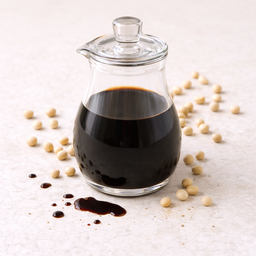
Soy Sauce
Fermented Asian sauce with deep umami
What is this ingredient?
Soy sauce is one of the world’s oldest fermented condiments, with a history of more than 2,000 years in China and later Japan. During traditional brewing, Aspergillus cultures, lactic acid bacteria and yeasts transform soybeans and wheat into a dark, complex sauce with saltiness, umami, mild sweetness and roasted aromas.
## Fermentation & melanoidins
During long maturation, melanoidins are formed: brown Maillard reaction products that contribute to the dark color, rounded flavor and aromatic depth of traditionally brewed soy sauce. Research such as Yamamoto et al. (2008) discusses these compounds in different soy sauces and shows that brewing time, recipe and heating strongly influence the composition.
## Umami & free glutamate
Soy sauce is rich in free glutamate, the compound responsible for its characteristic umami flavor. This means a small amount can add savory depth to rice, noodles, broths, vegetables, tofu, fish or meat. Umami is mainly a culinary effect: it rounds out flavors and can make dishes taste fuller without using large amounts of sauce.
## Sodium content
With around 5,500 mg sodium per 100 ml, soy sauce is very high in salt. Use small amounts, taste as you go and pair it with acidity, ginger, garlic, sesame oil or broth without extra salt. Reduced-salt versions often contain 25–40% less salt, but they remain concentrated flavorings.
How does it taste?
Deeply salty-umami with a fermented, mildly sweet undertone and roasted depth.
Pairs well with:
Pairs well with gingergarlicsesame oilricenoodlestofu and mushrooms.
Did you know...?
- Soy sauce is more than 2,000 years old and originated in China as a way to use salty fermentation liquid as a flavorful condiment.
- Traditionally brewed soy sauce often ferments for 6–18 months, while some industrial versions are made in a much shorter time.
Nutritional Value & Energy
Per 100ml
Soy Sauce provides energy thanks to natural nutrients .
Per 100g
Minerals
Vitamins
Omega-3 fatty acids
More nutrients
B-Vitamins
Trace Minerals
What's in a serving?
1 serving
Soy sauce naturally contains iron (2.4 mg per 100 g).
Soy sauce naturally contains manganese (0.5 mg per 100 g).
% of daily reference intake (DRI)
EU-approved nutrition claims
This ingredient contains nutrients for which EFSA-authorized health claims exist (at nutrient level, not ingredient-specific).
Approved health claims (EU)
Iron EU 432/2012
Iron contributes to normal energy-yielding metabolism
Contains 2.4mg/100g (threshold: ≥2.1mg/100g)
Iron EU 432/2012
Iron contributes to the reduction of tiredness and fatigue
Contains 2.4mg/100g (threshold: ≥2.1mg/100g)
Iron EU 432/2012
Iron contributes to normal cognitive function
Contains 2.4mg/100g (threshold: ≥2.1mg/100g)
Iron EU 432/2012
Iron contributes to normal formation of red blood cells and haemoglobin
Contains 2.4mg/100g (threshold: ≥2.1mg/100g)
Iron EU 432/2012
Iron contributes to normal oxygen transport in the body
Contains 2.4mg/100g (threshold: ≥2.1mg/100g)
Iron EU 432/2012
Iron contributes to the normal function of the immune system
Contains 2.4mg/100g (threshold: ≥2.1mg/100g)
Iron EU 432/2012
Iron has a role in the process of cell division
Contains 2.4mg/100g (threshold: ≥2.1mg/100g)
Manganese EU 432/2012
Manganese contributes to normal energy-yielding metabolism
Contains 0.5mg/100g (threshold: ≥0.3mg/100g)
Manganese EU 432/2012
Manganese contributes to the maintenance of normal bones
Contains 0.5mg/100g (threshold: ≥0.3mg/100g)
Manganese EU 432/2012
Manganese contributes to the normal formation of connective tissue
Contains 0.5mg/100g (threshold: ≥0.3mg/100g)
Manganese EU 432/2012
Manganese contributes to the protection of cells from oxidative stress
Contains 0.5mg/100g (threshold: ≥0.3mg/100g)
What's being researched?
Melanoidins in soy sauce
Melanoidins and isoflavones in naturally brewed soy sauce are studied for their contribution to color, aroma and product composition. The high sodium content remains important when considering portion size and frequency of use.
Supported by: [1] Ahouagi VB (2021)
Good Combinations (Synergy)
Combine soy sauce smartly to enhance the effect:
Soy Sauce 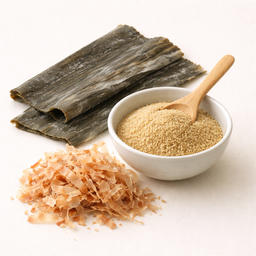 Dashi
Dashi Umami stacking: glutamate + inosinate = 8x flavor
Technical: Dashi (kombu + bonito) combines two umami sources: glutamate from kombu and inosinate from bonito. Miso/soy sauce adds a third source: more glutamate from soy fermentation. The synergistic effect of glutamate + inosinate amplifies flavor perception up to 8x — the scientific basis of Japanese cuisine.
What does this mean for you? Dissolve miso in dashi for the most flavorful soup. The combination activates your taste buds 8x stronger than each ingredient alone — this is Japan's umami secret.
Soy Sauce 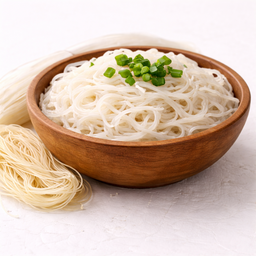 Rice Noodles
 Sesame + soy = complete amino acids + fats
Technical: Rice noodles (rice flour) are low in lysine — the limiting amino acid in rice protein. Soy sauce (fermented soybeans) is rich in lysine and provides free glutamate for umami. Sesame oil contains methionine (complementary amino acid) plus sesamin and sesamol — unique lignans with antioxidant action. Together they form an amino acid-complete profile.
What does this mean for you? Stir-fry rice noodles with sesame oil and soy sauce — this is the foundation of countless Asian dishes. The three together provide complete proteins, healthy fats AND intense umami flavor. Add vegetables for a complete meal.
Soy Sauce 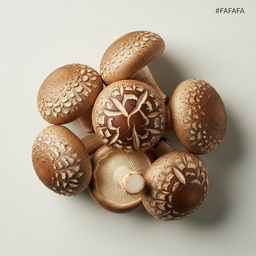 Shiitake
 Double umami for satiety + less salt needed
Technical: Shiitake contains guanylate (GMP), soy sauce contains glutamate (MSG). Together they create 'umami synergy' — the flavor-enhancing effect is 7-8x stronger than either alone. This activates T1R1/T1R3 receptors on the tongue AND in the stomach, triggering satiety signals.
What does this mean for you? Use shiitake with soy sauce instead of extra salt. You need less soy sauce for the same flavor intensity, supporting sodium reduction.
Soy Sauce 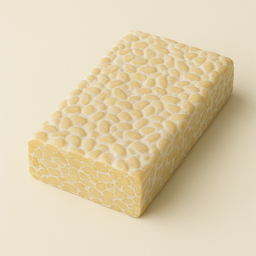 Tempeh
 Double fermented: complete umami + enhanced isoflavone absorption
Technical: Tempeh and soy sauce are both fermented from soybeans but through different processes. Tempeh contains Rhizopus oligosporus, soy sauce Aspergillus. Together they provide: complete amino acid profile, umami (glutamate from soy sauce enhances flavor), and increased isoflavone bioavailability through fermentation.
What does this mean for you? Marinate tempeh in soy sauce with ginger and garlic, then fry. This is the standard Indonesian preparation method.
Recipes with Soy Sauce
Discover delicious recipes featuring soy sauce:
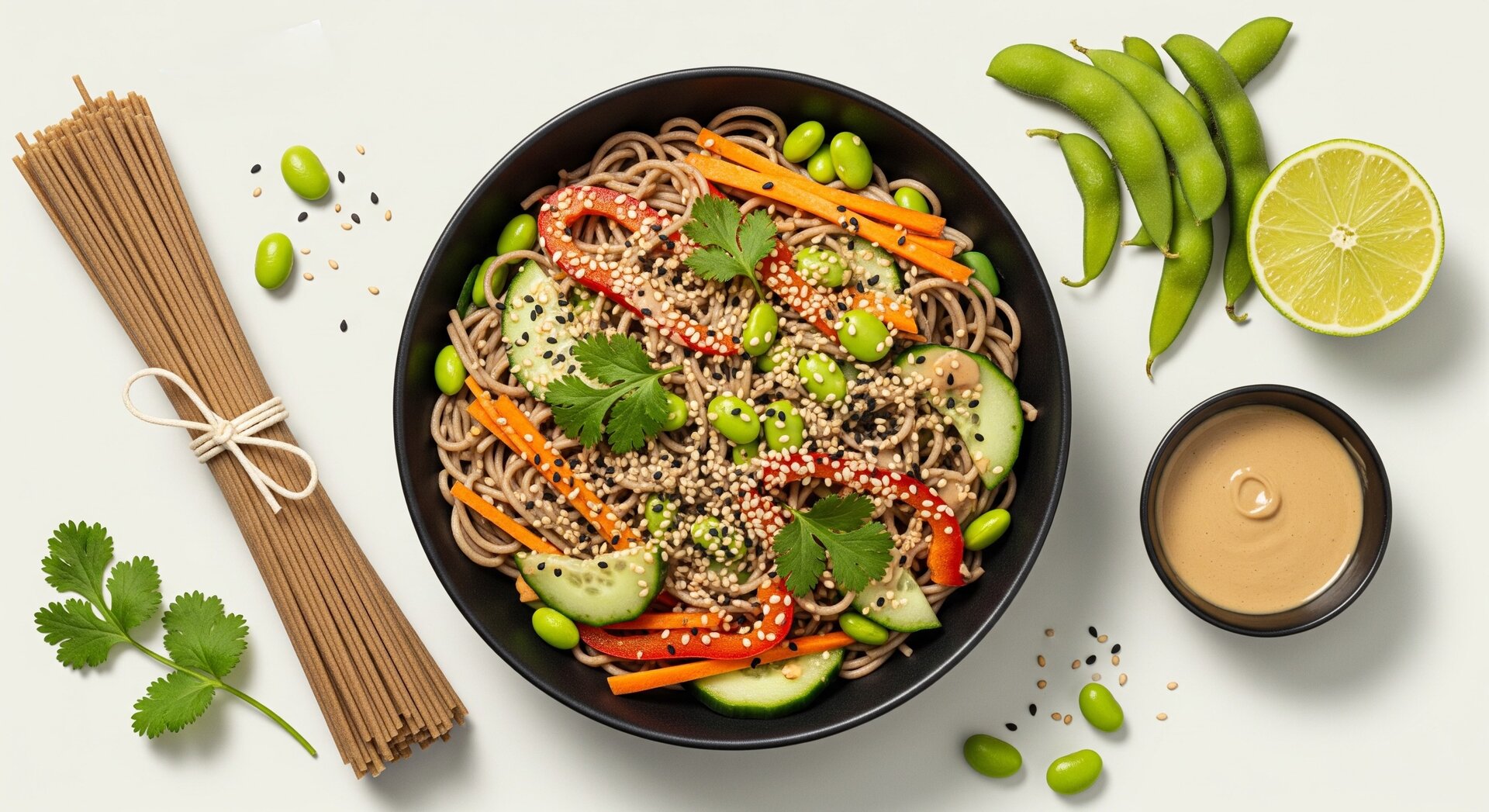 Asian Sesame-Soba Noodle Salad with Edamame 25 min Cold noodle salad with sesame dressing and edamame
  751 kcal
  31g protein 1 synergies
 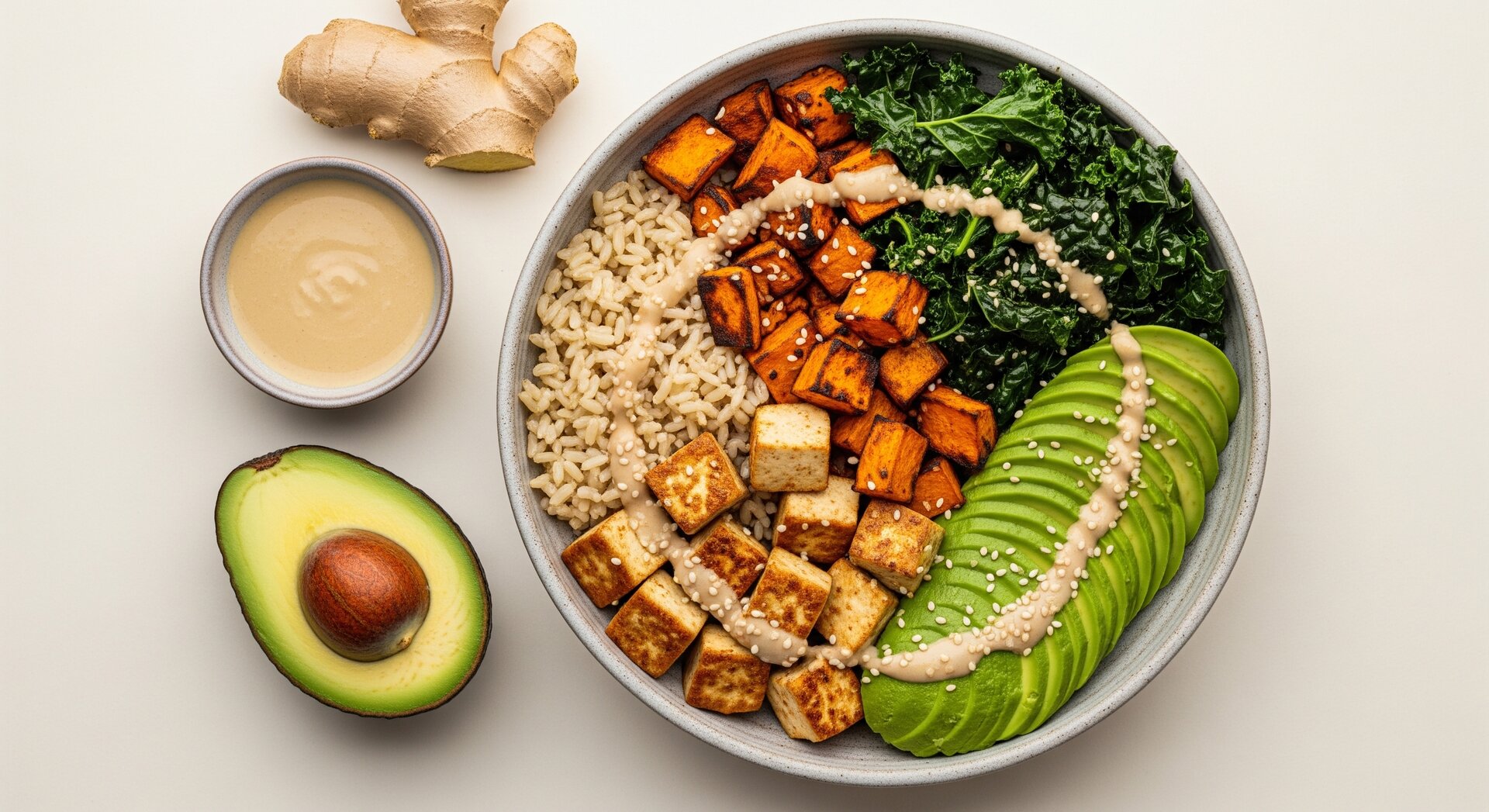 Buddha Bowl with Tofu, Sweet Potato and Kale 50 min Warm bowl with roasted vegetables 790 kcal 30g protein 3 synergies
 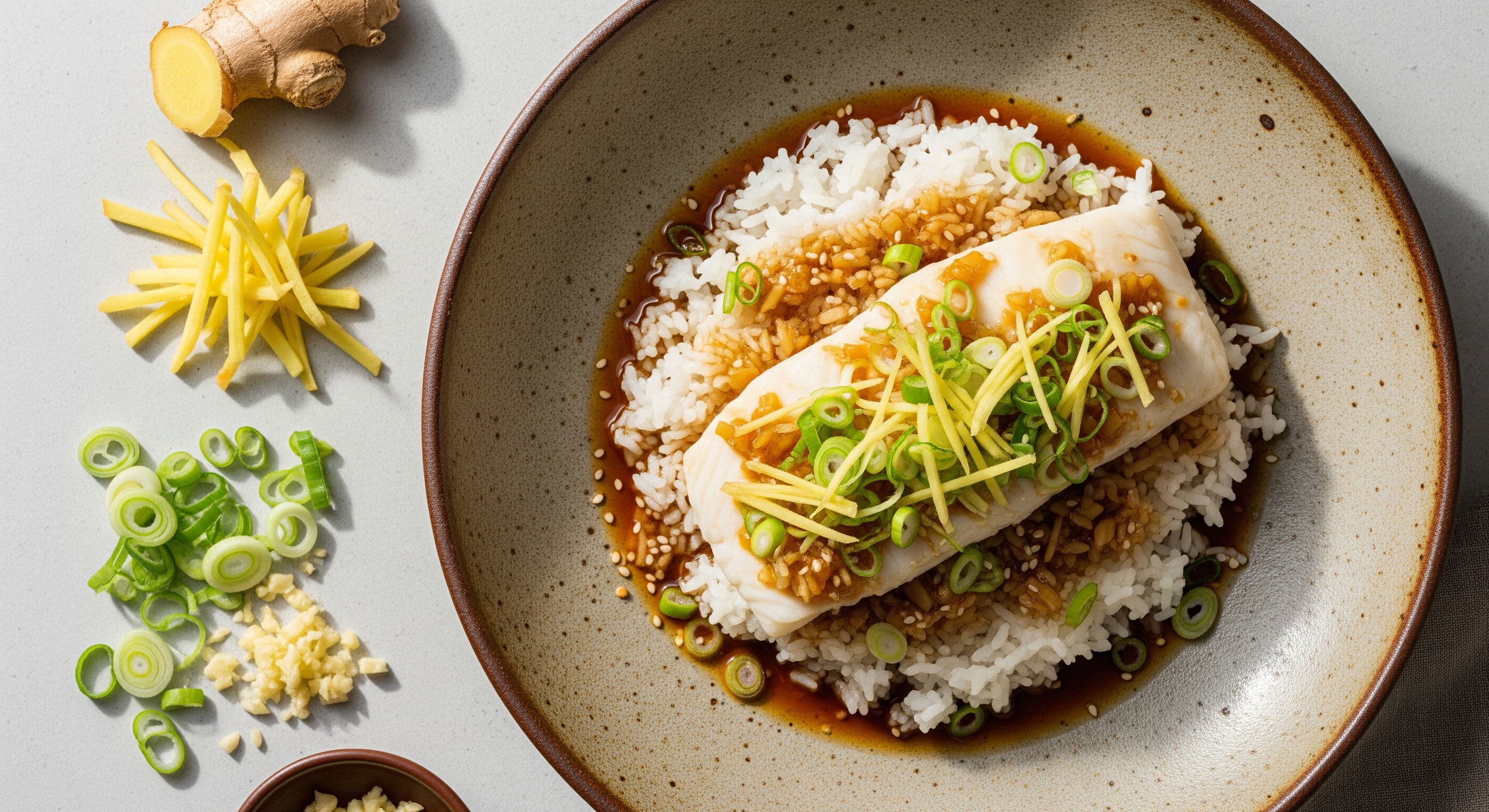 Steamed Fish with Ginger and Soy Sauce on Rice 25 min Light Cantonese classic with fresh ginger, soy sauce and sesame oil 580 kcal 36g protein 2 synergies
 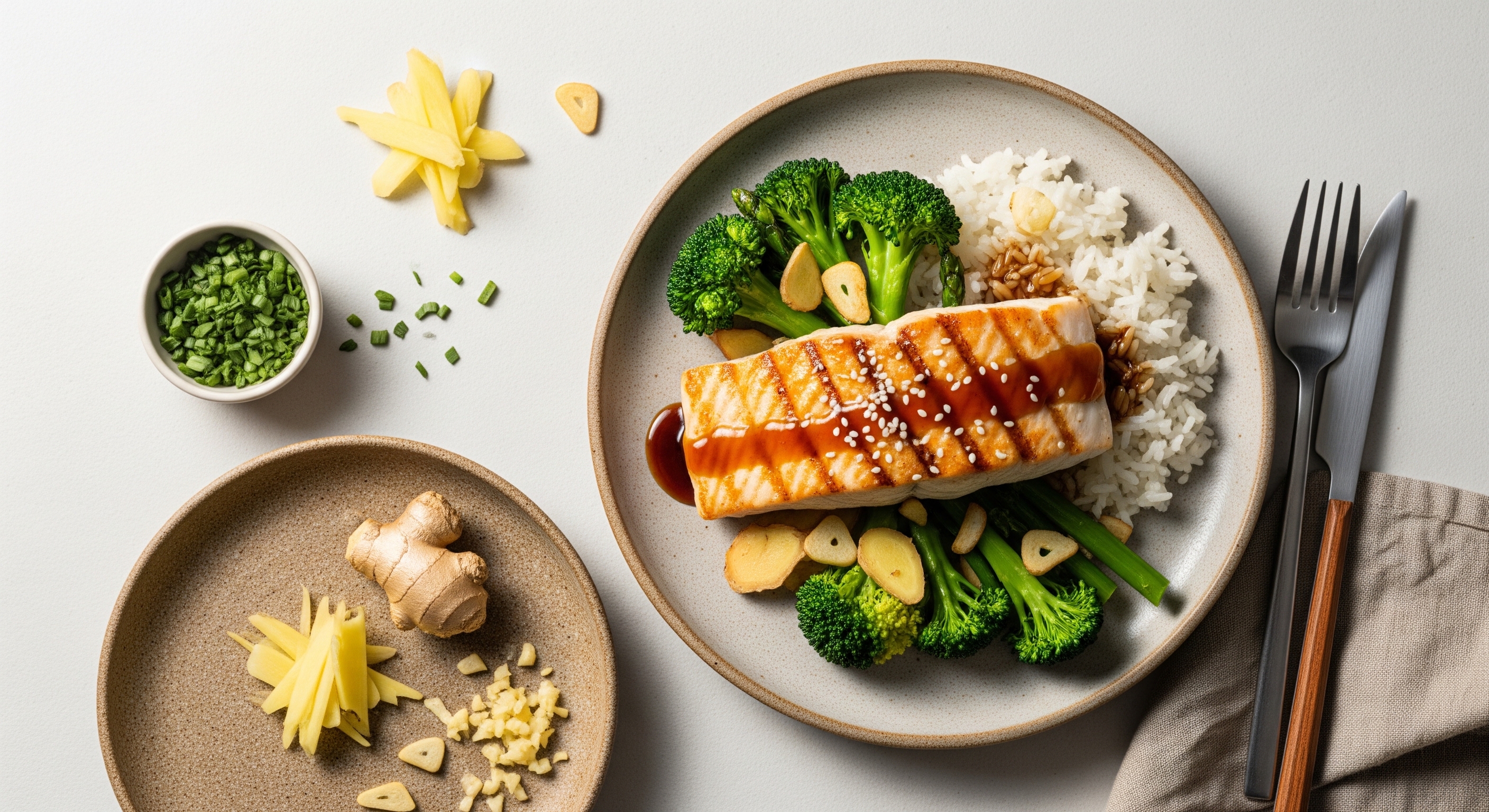 Halibut Teriyaki Bowl with Vegetables 35 min Japanese bowl with crispy pan-fried halibut and vegetables in teriyaki glaze 580 kcal 38g protein 2 synergies
 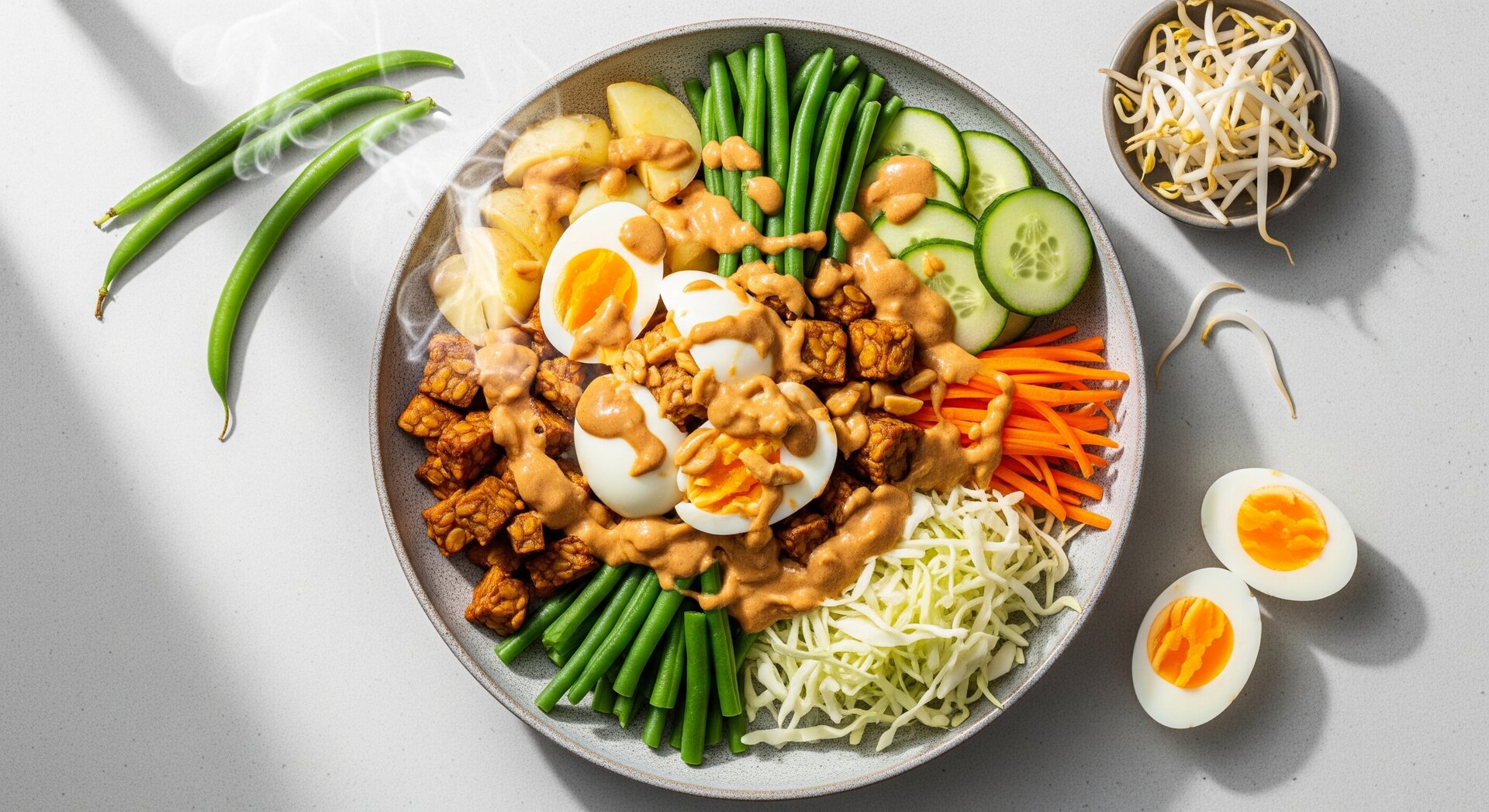 Indonesian Gado-Gado with Peanut Sauce & Tempeh 35 min Indonesian salad with fried tempeh, vegetables, egg and creamy peanut sauce 742 kcal 34g protein 2 synergies
 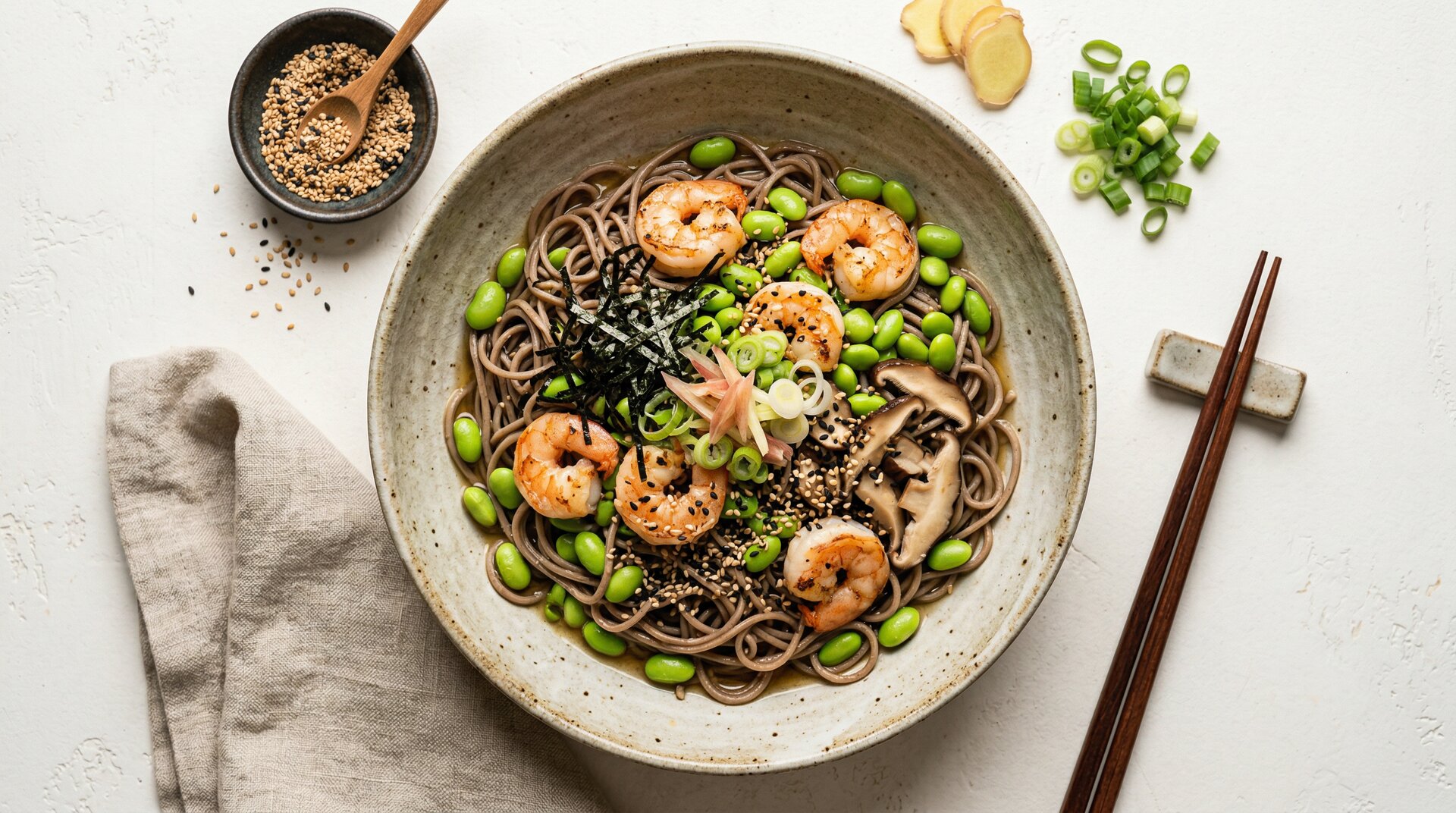 Japanese Shrimp Edamame Soba Noodles 25 min Buckwheat noodles with shrimp, edamame and an umami dressing 560 kcal 34g protein 2 synergies
  In the Kitchen
Storage
Location:Pantry
Shelf life:2-3 jaar, koelen verlengt smaak
Preparation
Add to marinades, stir-fries, dips, sushi, noodles and broths. Start with a small amount and taste, because the salty umami flavor quickly becomes dominant.
Conversions
Substitutes
Smart preparation
1Store opened soy sauce in the fridge to preserve aroma.
2Use light soy sauce for salty umami and dark soy sauce for color, roundness and deeper aromas.
Why?
Dark soy sauce is often thicker and slightly sweeter, so it colors dishes more quickly.
3Add soy sauce near the end when stir-frying.
Why?
This keeps the aroma fresh and prevents the sauce from reducing too much.
Caution / Warnings
Soy Sauce is very safe, but there are scientific considerations:
Soy allergy Severe
Made from soy; avoid completely with a known soy allergy.
Gluten intolerance Severe
Many classic soy sauces contain wheat. Tamari is often a more suitable alternative, but always check the label.
Salt-restricted diet Moderate
Very high sodium content, around 5,500 mg per 100 ml. Use small amounts or choose a reduced-salt version.
Traditional use
Traditional Chinese Medicine
Soy sauce in Chinese tradition
Soy sauce (jiang you) originated in China more than 2,000 years ago as a liquid seasoning from fermented soybeans. It later developed regional styles in Japan, Korea and Southeast Asia.
Summary
Traditionally brewed soy sauce is a concentrated umami seasoning with melanoidins from fermentation. Use sparingly: the flavor is powerful and the sodium content is very high.