Green Curry Paste
Aromatic Thai spice paste with fresh chili, lemongrass and galangal
What is this ingredient?
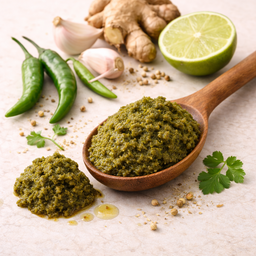
Green curry paste (พริกแกงเขียวหวาน, prik gaeng khiao wan) is a classic Thai spice paste and the base of dishes such as gaeng khiao wan. Its green color comes from fresh green chilies, green herbs and sometimes extra cilantro leaves or Thai basil.
## Aromatic Herbs
The paste combines lemongrass, galangal, coriander root or seed, garlic, shallot, makrut lime peel and Thai basil. These ingredients provide characteristic aroma compounds such as citral, galangin, linalool and eugenol. In cooking, they create a fresh, herbal and citrusy profile with chili heat and the depth of toasted spices.
## Capsaicin and Heat
Green chilies contain capsaicin, the compound responsible for their hot taste. The amount varies strongly by chili type and by how much paste you use. Coconut milk, oil and slightly sweet ingredients round out the heat, so green curry can taste fresh, creamy and spicy at the same time.
## Homemade vs. Store-bought
Homemade paste gives you maximum control over salt, sugar, chili level and freshness. Store-bought versions are convenient, but they vary widely in salt, oil, sugar and preservatives. For the best flavor, fry the paste briefly in oil before adding coconut milk or stock; this helps release the aromatic oils.
How does it taste?
Fresh-spicy with citrusy lemongrass, floral galangal, green herbs and clear chili heat.
Pairs well with:
Pairs well with coconut milkchickentofubamboo shootseggplant and Thai basil.
Did you know...?
- Green curry paste can be hotter than red curry because it often uses fresh green chilies.
- The green color comes from fresh green chilies, cilantro leaves and Thai basil.
Nutritional Value & Energy
Per 100g
Green Curry Paste provides energy thanks to natural nutrients .
Per 100g
Minerals
Vitamins
More nutrients
B-Vitamins
Trace Minerals
What's in a serving?
1 serving
Green Curry Paste naturally contains vitamin c (3.86 mg per 100 g paste). At typical spice usage (2–22.5 g), the contribution is limited.
Green Curry Paste naturally contains vitamin a (67.57 mcg per 100 g paste). At typical spice usage (2–22.5 g), the contribution is limited.
% of daily reference intake (DRI)
EU-approved nutrition claims
This ingredient contains nutrients for which EFSA-authorized health claims exist (at nutrient level, not ingredient-specific).
What's being researched?
Aromatic compounds in green curry paste
The combination of galangal, lemongrass, makrut lime and chili in green curry paste is studied in food science, especially for aroma, heat, preparation and interactions between spices.
Supported by: [1] Whiting (2014) , [2] Platel (2004) , [3] Mukarram M (2021)
Good Combinations (Synergy)
Combine green curry paste smartly to enhance the effect:
Green Curry Paste  Lemon
Lemon Vitamin C protects heat-labile curry paste antioxidants
Technical: When cooking green curry, some volatile terpenes (citral, citronellol) are partially lost through evaporation and oxidation. Lemon's vitamin C (53mg) and citric acid act as antioxidants protecting remaining terpenes from further oxidative degradation. Vitamin C also increases iron absorption from spices in the paste by 3-6x. Lemon's acidity also activates taste perception of other ingredients.
What does this mean for you? Squeeze lemon over your green curry just before serving. This restores the freshness partially lost during cooking and improves mineral absorption from the spices.
Green Curry Paste  Ginger
 Curry paste terpenes + gingerols for synergistic bioactive action
Technical: Green curry paste combines citral (lemongrass), ACA (galangal) and capsaicin (green peppers) — three independent bioactive compounds. Ginger adds gingerols that modulate COX-2 via a fourth mechanism (prostaglandin modulation). Together they influence 4+ signaling pathways: NF-kB (galangal), COX-2 (ginger), TRPV1 (capsaicin) and LOX (lemongrass). This makes Thai curry one of the most bioactive-rich dishes.
What does this mean for you? Add extra fresh ginger to your green curry for a broader bioactive profile. The ginger enhances what the curry paste already does via a different mechanism.
Green Curry Paste  Coconut Milk
 Capsaicin + MCT fats for optimal spice absorption
Technical: Green curry paste contains galangal (ACA antioxidant), lemongrass (citral), kaffir lime (citronellol), green peppers (capsaicin) and coriander roots. All these active compounds are partially fat-soluble. Coconut milk's MCTs (15% of fats) and lauric acid (48%) form micelles that increase bioavailability 3-5x. Capsaicin dissolves completely in coconut fat, extending the thermogenic response.
What does this mean for you? Green curry with coconut milk isn't just a classic combination — it's scientifically optimized. The coconut milk dissolves the active compounds from the paste so your body can use them.
Recipes with Green Curry Paste
Discover delicious recipes featuring green curry paste:
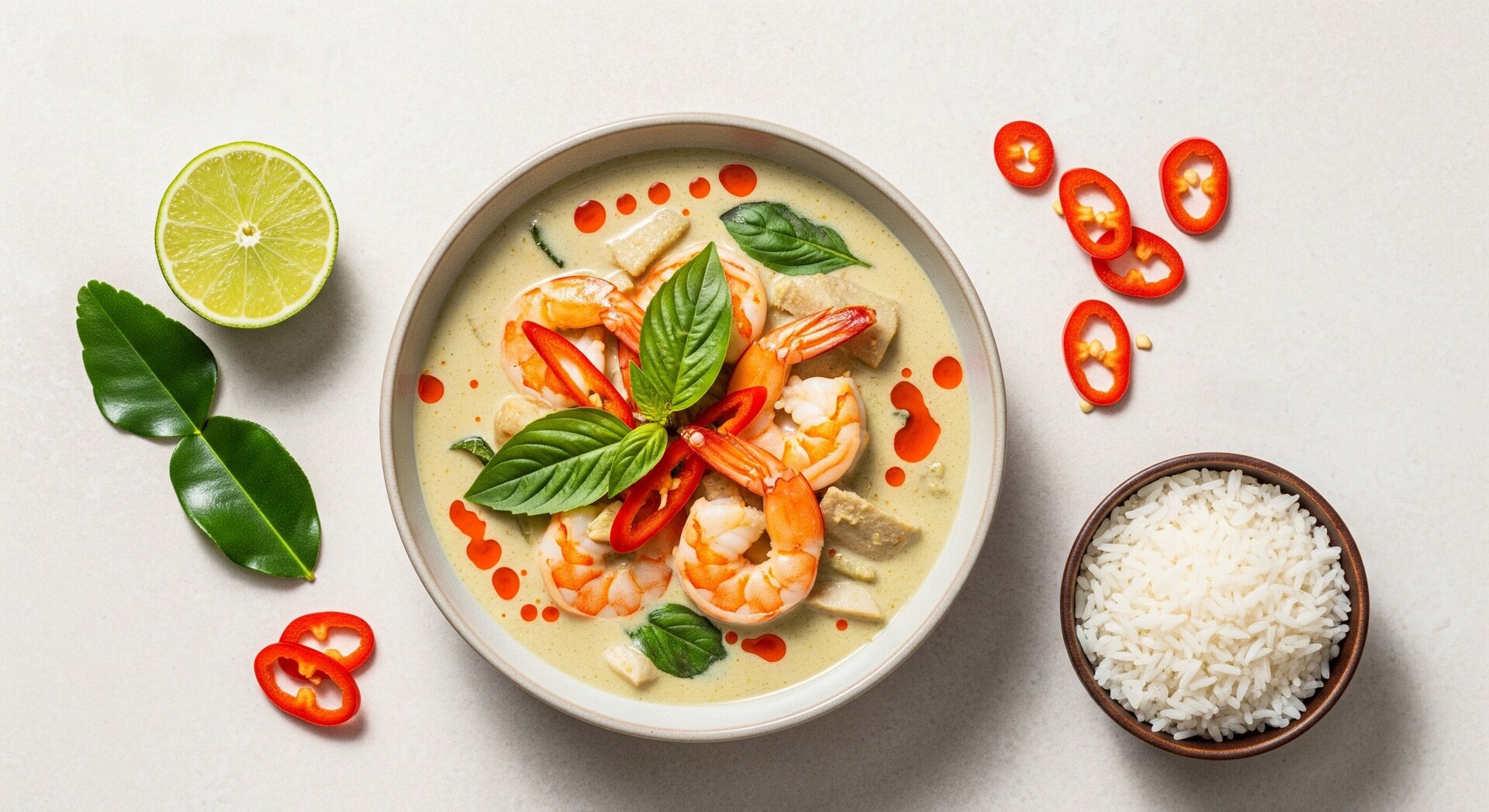 Thai Green Curry with Shrimp and Coconut 35 min Creamy green curry with juicy shrimp and Thai basil
  716 kcal
  46g protein 1 synergies
 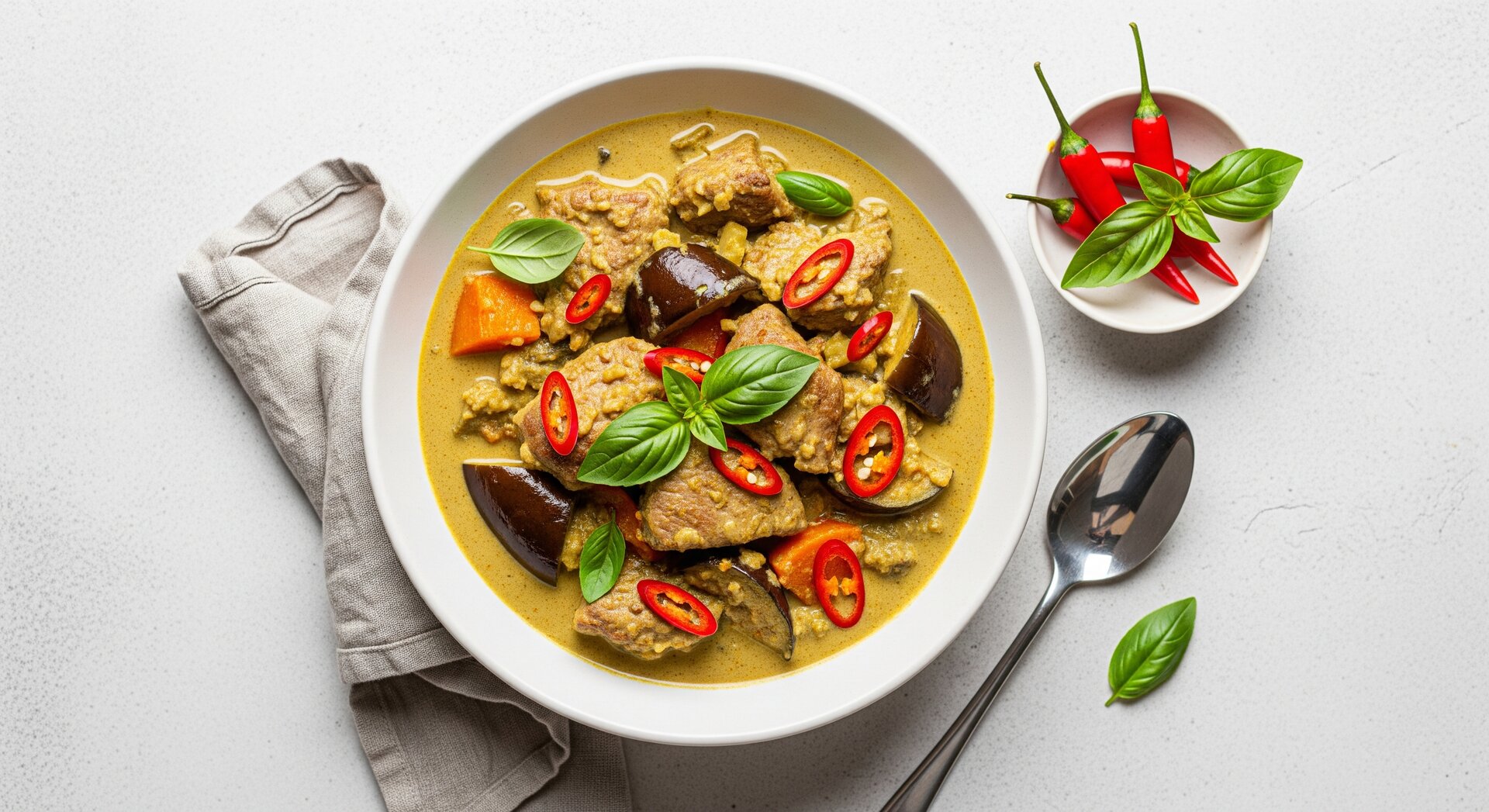 Thai Green Curry with Chicken 35 min Creamy coconut curry with fresh vegetables 520 kcal 32g protein 1 synergies
  In the Kitchen
Storage
Location:Refrigerator
Shelf life:2 weken in koelkast, 3 maanden in vriezer
Store in a clean glass jar in the fridge. For individual portions, freeze the paste in ice cube trays and then pack it airtight.
Preparation
Fry for 1-2 minutes in oil over medium heat until the aromas release. Then add coconut milk, stock or vegetables and simmer gently until the sauce tastes rounded and fragrant.
Conversions
Substitutes
Smart preparation
1Fry green curry paste for 1-2 minutes in oil before adding coconut milk.
Why?
This releases the aromatic oils and gives the sauce a deeper flavor.
2Start with less paste than the recipe says; you can always add more.
3Store opened curry paste in the fridge with a thin layer of oil on top.
Caution / Warnings
Green Curry Paste is very safe, but there are scientific considerations:
Stomach ulcers or reflux symptoms Moderate
Spicy ingredients may cause irritation or a burning sensation in sensitive people, especially when the paste is used generously.
Advice:
Start with a small amount, combine with coconut milk or extra vegetables, and choose a milder spice paste if heat causes discomfort.
Traditional use
Southeast Asian
Green Curry Paste in Thai Tradition
Green curry paste is a traditional Thai ingredient prepared with a mortar and pestle from fresh green chilies, lemongrass, galangal, garlic, shallot and herbs.
Summary
Green curry paste is a fresh, spicy Thai base made with green chili, lemongrass, galangal, coriander and Thai basil. Fry the paste briefly in oil before adding coconut milk; this releases the aromas more fully. Homemade paste gives more control over salt, sugar and heat than many store-bought versions.